
Fannie Mae RefiNow™ is a loan option designed to make refinancing easier and less costly for existing Fannie borrowers. However, the program isn’t open to everyone, and those with above-average incomes in their area are excluded.
Still, for those with average or below-average incomes, RefiNow™ can be a very attractive option. You can get approved even if your credit score is lower and your debt-to-income (DTI) ratio is higher than those required for other Fannie refinances. And Fannie will pick up the tab for your appraisal if you need one.
Read on for the details.
The least you need to know
- To qualify for RefiNow™, you need an annual income at or below the average where you live. Learn how to discover your area average, below.
- This isn’t a cash-out refinance. The most you can take out is $250.
- It’s easier to qualify for RefiNow™ than other Fannie refinances.
- Closing costs are typically lower than usual because Fannie should pay for your appraisal.
- You must be current on your existing mortgage (which must be owned by Fannie) and not have missed a payment in the last six months. You can’t have missed more than one in the last year.
RefiNow™: The basics
Fannie Mae RefiNow™ was conceived when mortgage rates were much lower. Back then, many people on low or average incomes were desperate to refinance to reduce their rate and monthly payments.
However, they found closing costs and strict qualifying rules insurmountable barriers. So, Fannie designed RefiNow™ to address those issues, making these refinances less costly and more accessible to those on modest or average incomes who had poor credit or high levels of debt.
Today, mortgage rates have risen much higher than they were when RefiNow™ was launched. So, opportunities to refinance to a lower rate are currently rare.
Indeed, Fannie says you must reduce your current rate by at least 0.5% (50 basis points) in order to be approved for this program. At the time of writing, that would mean that only those with loans originated in late 2023 are likely to be eligible.
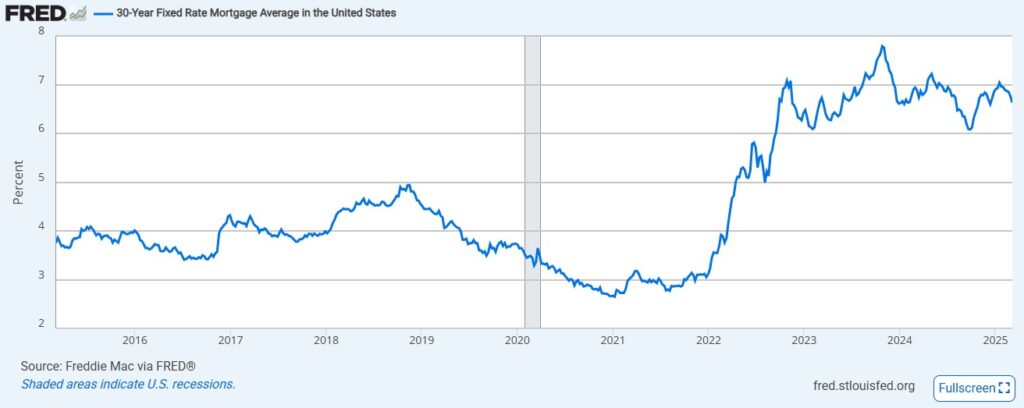
Source: Federal Reserve Bank of St. Louis
But we must hope that mortgage rates will drop again in the coming months and years. If they do, RefiNow™ could be a great choice for many borrowers.
RefiNow™: The benefits
The two key benefits that Fannie Mae RefiNow™ delivers are:
- They’re less costly than many other refinances. If you need an appraisal, Fannie says it will give you a $500 credit toward your closing costs, regardless of the appraiser’s actual fee.
- They have lower eligibility barriers than other loans.
That second one can be very important. Fannie imposes no minimum credit score on these refinances. And that’s a lifeline for those with damaged credit.
Easy debt-to-income threshold
As importantly, Fannie allows borrowers to have exceptionally high debt-to-income (DTI) ratios. Your DTI is calculated by dividing your total monthly debt payments by your gross monthly income and multiplying by 100.
For example, suppose your new homeownership payments, minimum card payments, auto, personal and student loan payments, and child support or alimony payments add up to $2,000. Now, let’s assume that your monthly income (before taxes) is $6,000.
$2,000 ÷ $6,000 = 0.3333 or a DTI of 33.3%
You may be approved for most mortgages and refinances providing your credit score is good enough and you have a big enough down payment or sufficient retained equity.
However, suppose your monthly debt payments add up to $3,000 of your $6,000 salary. You can do that sum in your head: you have a 50% DTI. And that’s too high for most refinances. Only FHA loans routinely have a higher cap: 57%.
But Fannie Mae RefiNow™ caps your DTI at a whopping 65%. Clearing away credit score and DTI barriers makes this program accessible to many more borrowers than others.
Lender-specific criteria
Although Fannie sets the rules for RefiNow™, individual lenders are free to impose their own, tougher standards. So, some lenders may be unable to approve a loan application with a very low credit score or very high DTI.
RefiNow™ eligibility requirements
You need two things to be in with a chance of getting a Fannie Mae RefiNow™ refinance:
- An existing Fannie Mae loan
- An income that’s at or below the average in your area
But you may not be sure about either of those. Not all loans that are Fannie-branded when they’re originated go on to be Fannie-owned. And how are you supposed to know what your area median income (AMI) is so you can compare it with yours?
Luckily, Fannie makes it easy to know both your loan’s status and your AMI. It provides two online lookup tools on its website to let you find out:
Simply, click on those links, provide the required information, and Voila!
One point still needs clarifying. Suppose there are two or more borrowers on your loan agreement. How does that affect your AMI?
Fannie says, “ … the lender must include the income from all borrowers who will sign the note, to the extent that the income is considered in evaluating creditworthiness for the loan. For example, if there are two borrowers on the loan application, the lender will use the combined total qualifying income amount to determine whether the 100% AMI limit has been met.”
Other eligibility criteria
There are some other eligibility criteria, only some of which we’ve already mentioned. The:
- Loan must be secured by a single-unit dwelling (not a duplex, triplex or other multi-unit structure)
- Dwelling must be the borrower’s principal residence
- Borrower’s “current income must be at or below 100% of the area median income”
- Borrower must be current on the existing mortgage and have “no missed payments on their current mortgage loan in the past six months, and no more than one missed payment in the past 12 months”
- Refinance mortgage must be 97% or less of the home’s appraised value
- Borrower’s debt-to-income ratio can’t be higher than 65%
- New interest rate must be at least 0.5% (50 basis points) lower than the existing mortgage’s rate
- New monthly payment (including principal, interest, and any private mortgage insurance premiums) must be lower than the existing one
Most of these won’t be a challenge for most borrowers.
When to consider a Fannie Mae RefiNow™ refinance
The purpose of the RefiNow™ program is clear. It’s intended to give borrowers on low and average incomes access to lower mortgage rates and monthly payments.
Indeed, you can’t use Fannie Mae RefiNow™ unless you’re going to achieve those goals. You’re excluded by numbers 7 and 8 in the last set of bullet points.
But how much lower a rate and payment do you need to justify the closing costs that come with every refinance? Fannie sets the minimum at 0.5% off your current rate.
That may work for you, depending on your circumstances. But some mortgage experts suggest waiting until you can shave off a full 1%.
It’s a good idea to work out the “breakeven point” for your refinance. That’s the time your savings will take to repay the closing costs you’ve spent. Use our breakeven calculator to help you model your options.
If it’s going to take you several years to recoup your closing costs, you may prefer to wait for rates to dip even lower. And, if you think you’ll likely move before you recover that money, a refinance likely isn’t a great idea right now.
How we source rates and rate trends
Rates based on market averages as of Dec 02, 2025.Product Rate APR 15-year Fixed Refinance 5.37% 5.42% 30-year Fixed Refinance 6.35% 6.37%
How to get a RefiNow™ loan
Here are the nine steps you need to take to get a Fannie Mae RefiNow refinance:
- Check your loan to see that it’s owned by Fannie Mae (use the link, above)
- Make sure your income is at or below your area’s AMI (use the link, above)
- Check current mortgage rates are at least 0.5% below the one you’re paying
- Make sure you meet the other eligibility criteria
- Request quotes (“loan estimates”) from at least three Fannie-approved lenders so you can compare them and get your best deal
- Apply to the lender offering the best deal
- Provide all the paperwork the lender requires to support your application
- Wait for your appraisal and the underwriting process to grind through
- Close on your new loan and begin paying a lower rate and smaller monthly payment
It’s not rocket surgery!
Similar options
If your mortgage isn’t owned by Fannie Mae, check whether it’s owned by Freddie Mac, the other major conventional loan agency in the U.S. Freddie’s Refi Possible® program offers many of the benefits of RefiNow™ and may be perfect for you.
Alternatively, you may wish to explore switching to an FHA loan, which is open to most borrowers. If you’re eligible for a VA loan or USDA loan, they may prove even better.
If things are getting desperate and you’re worried you might face foreclosure, talk to your lender about a loan modification. It should try to help you out with ways to reduce your monthly payment, at least for a while.
Fannie Mae RefiNow™: A strong option for borrowers on lower incomes
You should now see the value and benefits of RefiNow™. It really can provide a lifeline to those on average and low incomes.
Depending on where mortgage rates are when you read this, you may not be able to use the program now. Current rates may be too high to shave off the minimum of 0.5% from your existing rate that you need.
But file away this article somewhere safe. If and when mortgage rates do finally drop, you might be glad you did.
Fact-checked by Tim Lucas